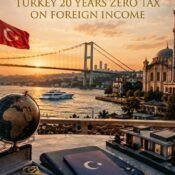


Zero Tax Turkey: Turkey’s 20-Year Foreign Income Tax Exemption for New Residents (2026 Guide)
Turkey is preparing to introduce what many international investors are already calling the “Zero Tax Turkey” regime, a proposed tax reform that could transform the country into one of the world’s most attractive destinations for global wealth, entrepreneurs, retirees, and internationally mobile professionals.
Under a proposed amendment to the Turkish Income Tax Law, qualifying individuals who become Turkish tax residents may receive a 20-year exemption from Turkish income tax on foreign-source income and earnings.
If enacted in its current form, the new regime could allow eligible residents to legally live in Turkey while paying 0% Turkish income tax on foreign dividends, overseas rental income, capital gains, investment returns, and certain pensions for up to two decades.
Combined with Turkey’s strategic location, affordable luxury lifestyle, residency-by-investment programs, and growing financial infrastructure, the proposal could position Turkey as a major competitor to Dubai, Portugal, Italy, Greece, and other low-tax jurisdictions.
Turkey’s Vision: Becoming a Global Investment Hub
The Turkish government has made it clear that economic transformation and foreign investment are central to its long-term ambitions. Istanbul is being promoted as a regional financial center capable of competing with established hubs such as Dubai, Singapore, and Hong Kong.
The proposed reforms come at a strategic moment, as investors and expatriates seek politically stable, tax-efficient alternatives across Europe and the Middle East.
Turkey’s geographic location, modern infrastructure, growing financial sector, and relatively affordable real estate market already make it attractive. The addition of aggressive tax incentives could significantly strengthen its appeal.
What Is Zero Tax Turkey?
“Zero Tax Turkey” is the informal name being used to describe Turkey’s proposed foreign-source income tax exemption regime.
The draft legislation would introduce a new article into the Turkish Income Tax Law titled:
Tax Exemption for Foreign-Source Income and Earnings
Under this proposal, qualifying individuals who relocate to Turkey and become Turkish tax residents may not pay Turkish income tax on eligible foreign income for up to 20 years.
This would effectively create one of the most generous long-term tax residency systems currently proposed anywhere in the world.
Key Features of the Zero Tax Turkey Regime
The proposed regime includes several highly attractive features for foreign investors and expats.
Main Benefits
- 20-year exemption from Turkish tax on qualifying foreign income
- 0% Turkish income tax on eligible overseas earnings
- Available to new Turkish tax residents
- No annual Turkish income tax return for exempt foreign income
- Existing passive Turkish income does not automatically disqualify applicants
- Potentially effective for individuals becoming Turkish tax residents from 1 January 2026
Zero Tax Turkey at a Glance
| Feature | Description |
|---|---|
| Regime Name | Zero Tax Turkey (informal name) |
| Legal Basis | No Turkish tax residency during the previous 3 years |
| Tax Exemption Duration | 20 years |
| Tax Rate on Qualifying Foreign Income | 0% in Turkey |
| Eligibility Requirement | No Turkish tax residency during previous 3 years |
| Proposed Start Date | 1 January 2026 |
| Tax Return Requirement | No reporting for exempt foreign income |
How Zero Tax Turkey Works
If you relocate to Turkey and satisfy the eligibility requirements, qualifying foreign-source income may become fully exempt from Turkish income tax.
This means Turkey would potentially not tax income, such as:
- Foreign dividends
- Overseas interest income
- Foreign rental income
- Capital gains from global securities
- Investment fund profits
- Royalty and licensing income
- Certain foreign pensions
Importantly, Turkish-source income would remain taxable under standard Turkish tax rules.
Who Can Benefit from Zero Tax Turkey?
The regime could be especially attractive for internationally mobile individuals with significant foreign assets or passive income streams.
Entrepreneurs After a Business Exit
Founders who sell companies and hold wealth internationally may significantly reduce long-term tax exposure.
Investors With International Portfolios
Individuals earning global dividends, interest, and capital gains may benefit from tax-free treatment in Turkey.
Retirees
Foreign retirees receiving pension income or investment returns may enjoy a tax-efficient lifestyle in Turkey.
Digital Nomads and Remote Professionals
Professionals with non-Turkish income sources may find Turkey highly attractive.
Family Offices and Wealthy Families
The proposed inheritance tax reductions and long-term certainty may support succession planning strategies.
Turkish Citizens Returning From Abroad
Former Turkish residents who have lived overseas for several years may also qualify.
Eligibility Requirements for Zero Tax Turkey
To qualify for the proposed exemption, several conditions must be met.
1. Become a Turkish Tax Resident
The individual must satisfy Turkish tax residency rules.
Typically, this includes:
- Spending substantial time in Turkey, or
- Establishing habitual residence in the country.
Applicants must not have maintained legal Turkish residence during the prior three years.
3. No Turkish Tax Residency During the Previous Three Years
The applicant must not have been subject to Turkish taxation as a resident taxpayer during that period.
4. Income Must Be Foreign-Source
Only qualifying foreign-source income falls within the exemption.
Turkish-source income remains taxable.
Existing Turkish Investments May Not Prevent Qualification
One particularly important feature of the draft law is that passive Turkish income may not automatically disqualify applicants.
The proposal specifically suggests that prior Turkish tax registrations arising solely from:
- Rental income from Turkish property
- Turkish dividends or interest
- Capital gains
would not prevent access to the regime.
This is especially relevant for individuals who already own Turkish real estate or investment assets.
What Income Could Be Covered?
The legislation broadly references “foreign-source income and earnings.”
Potentially exempt categories may include:
- Dividends from foreign corporations
- Interest from overseas bank accounts
- Foreign rental income
- Capital gains from international investments
- Investment fund profits
- Licensing and royalty income
- Certain foreign pensions
The final scope will likely depend on regulations issued by the Turkish Ministry of Treasury and Finance.
Tax Filing Requirements Under Zero Tax Turkey
One of the biggest practical advantages is reduced compliance.
If the Exemption Applies
- No Turkish annual tax return may be required for exempt foreign income
- Exempt income may be excluded entirely from reporting
- Supporting documentation should still be retained for audit purposes
This could significantly simplify tax administration for foreign residents.
Important Risks and Compliance Considerations
Although highly attractive, the regime will likely require careful planning.
Potential Risks
If Turkish authorities later determine that qualification requirements were not met:
- Taxes may be assessed retroactively
- Penalties could apply
- Interest charges may be imposed
Professional tax advice will therefore remain essential.
Example: Zero Tax Turkey in Practice
A German entrepreneur relocates to Turkey in 2026 after several years abroad.
Her annual foreign income includes:
- EUR 400,000 in dividends
- EUR 250,000 in capital gains
- EUR 100,000 in overseas interest income
If the Zero Tax Turkey regime applies, this income could potentially remain fully exempt from Turkish taxation for up to 20 years.
Why Zero Tax Turkey Could Be a Game-Changer
Turkey’s proposal combines several advantages rarely found together in one jurisdiction.
Strategic Advantages
- 0% Turkish tax on qualifying foreign income
- Twenty years of potential tax certainty
- No reporting obligations for exempt income
- Lower living costs than in Dubai or Western Europe
- Strong international connectivity
- Modern healthcare and infrastructure
- Access to European, Middle Eastern, and Asian markets
- Attractive residency and citizenship programs
Zero Tax Turkey vs Other Low-Tax Countries
Turkey’s proposed regime could become one of the most competitive globally.
Turkey vs Dubai (UAE)
| Feature | Turkey | UAE (Dubai) |
|---|---|---|
| Foreign Income Tax | 0% proposed | 0% |
| Duration | 20 years | Unlimited while resident |
| Cost of Living | Lower | Very high |
| Real Estate Costs | Moderate | Expensive |
| Citizenship Option | Yes | Limited |
| Lifestyle | European + Middle Eastern | Gulf financial hub |
Key Difference
Dubai remains fully tax-free but offers limited citizenship pathways. Turkey combines low taxes with potential long-term residency and citizenship opportunities.
Turkey vs Portugal
| Feature | Turkey | Portugal |
|---|---|---|
| Regime Duration | 20 years | Formerly 10 years |
| Current Status | Proposed | NHR largely replaced |
| Tax on Foreign Income | 0% proposed | Partial exemptions |
| Cost of Living | Lower | Higher |
| Investment Entry | Property and investment routes | More restrictive |
Key Difference
Portugal’s famous NHR regime has become more limited, while Turkey’s proposal could offer longer and broader exemptions.
Turkey vs Italy
| Feature | Turkey | Italy |
|---|---|---|
| Foreign Income Tax | 0% proposed | Flat annual substitute tax |
| Duration | 20 years | 15 years |
| Wealth Tax | None proposed | Potential exposure |
| Lifestyle Costs | Lower | Higher |
Key Difference
Italy offers certainty through flat taxation, while Turkey could provide a complete exemption for qualifying foreign income.
Turkey vs Greece
| Feature | Turkey | Greece |
|---|---|---|
| Tax Regime | Proposed exemption | Flat-tax programs |
| Duration | 20 years | 15 years |
| Residency Costs | Lower | Moderate |
| Real Estate Prices | Competitive | Rising rapidly |
Key Difference
Turkey may provide broader exemptions and lower entry costs compared to Greece.
Turkish Citizenship and Residency Opportunities
Turkey already offers accessible residency and citizenship pathways through investment.
Citizenship by Investment
Foreign nationals may qualify by:
- Purchasing real estate worth at least USD 400,000, or
- Investing USD 500,000 into approved financial assets.
Residency Through Property Investment
Foreigners can also obtain residency permits through qualifying real estate purchases.
This combination of residency access and proposed tax exemptions could significantly increase international demand.
Could Turkey Become the Next Global Tax Hub?
Turkey appears to be positioning itself as a bridge between Europe, the Middle East, and Asia for globally mobile wealth.
If enacted, the Zero Tax Turkey regime could attract:
- Entrepreneurs
- Investors
- Family offices
- Retirees
- Digital nomads
- International professionals
The proposal reflects Turkey’s broader ambition to become a major international financial and investment center.
Conclusion
The proposed Zero Tax Turkey regime could become one of the most important international tax developments of the decade.
A potential 20-year exemption from Turkish tax on foreign-source income would place Turkey among the most competitive tax residency jurisdictions globally.
Combined with relatively low living costs, strong infrastructure, attractive real estate opportunities, and strategic geographic positioning, Turkey could emerge as a serious alternative to Dubai, Portugal, Italy, and Greece.
However, because the regime remains in draft form, individuals should seek professional tax and legal advice before making relocation or investment decisions.
Frequently Asked Questions
Is Zero Tax Turkey already the law?
No. The regime is currently based on draft legislation and must still be formally enacted by the Turkish parliament.
When could Zero Tax Turkey start?
The proposal suggests applicability for individuals becoming Turkish tax residents from 1 January 2026.
Does the regime apply to Turkish-source income?
No. Turkish-source income would still be taxed under normal Turkish tax rules.
What foreign income may be exempt?
Potentially:
- Dividends
- Interest income
- Rental income
- Capital gains
- Investment profits
- Royalties
- Certain pensions
Do I need to file a Turkish tax return?
Qualifying exempt foreign income may not require annual Turkish tax reporting.
Can existing Turkish property owners qualify?
Yes. Passive Turkish income from property or investments may not automatically disqualify applicants.
How long does the exemption last?
Up to 20 years.
Can Turkish citizens qualify?
Potentially yes, especially Turkish citizens returning after several years abroad.
Is Turkey cheaper than Dubai?
In most categories, yes. Housing, lifestyle, and operational costs are generally lower in Turkey than in Dubai.
Should I move to Turkey for tax reasons alone?
Tax should never be the only consideration. Residency rules, lifestyle, immigration, treaty implications, and home-country tax laws must also be carefully reviewed.
Recent Posts

E-Government Verification for Real Estate Listings